
If you are studying the National Incident Management System (NIMS), one question that often appears in training materials and emergency management exams is: which NIMS structure makes cooperative multi-agency decisions? The answer is the Multiagency Coordination Group, commonly called the MAC Group.
MAC Groups are an important part of the NIMS command and coordination framework. They bring together representatives from different agencies and organisations so that important policy-level decisions can be made collectively. Rather than directing responders in the field, the group helps coordinate priorities, resources and decisions across organisations involved in a complex incident.
Understanding the difference between a MAC Group, an Emergency Operations Centre (EOC), the Incident Command System (ICS) and the Joint Information System (JIS) makes this question much easier to remember. Each structure has a different role, and knowing those roles is essential for understanding how NIMS works during emergencies.
What Is the Correct Answer?
The correct answer is Multiagency Coordination Group (MAC Group). FEMA describes MAC Groups as part of the off-site incident management structure within NIMS. They are sometimes referred to as policy groups because their work focuses on higher-level guidance and coordination rather than direct tactical incident command.
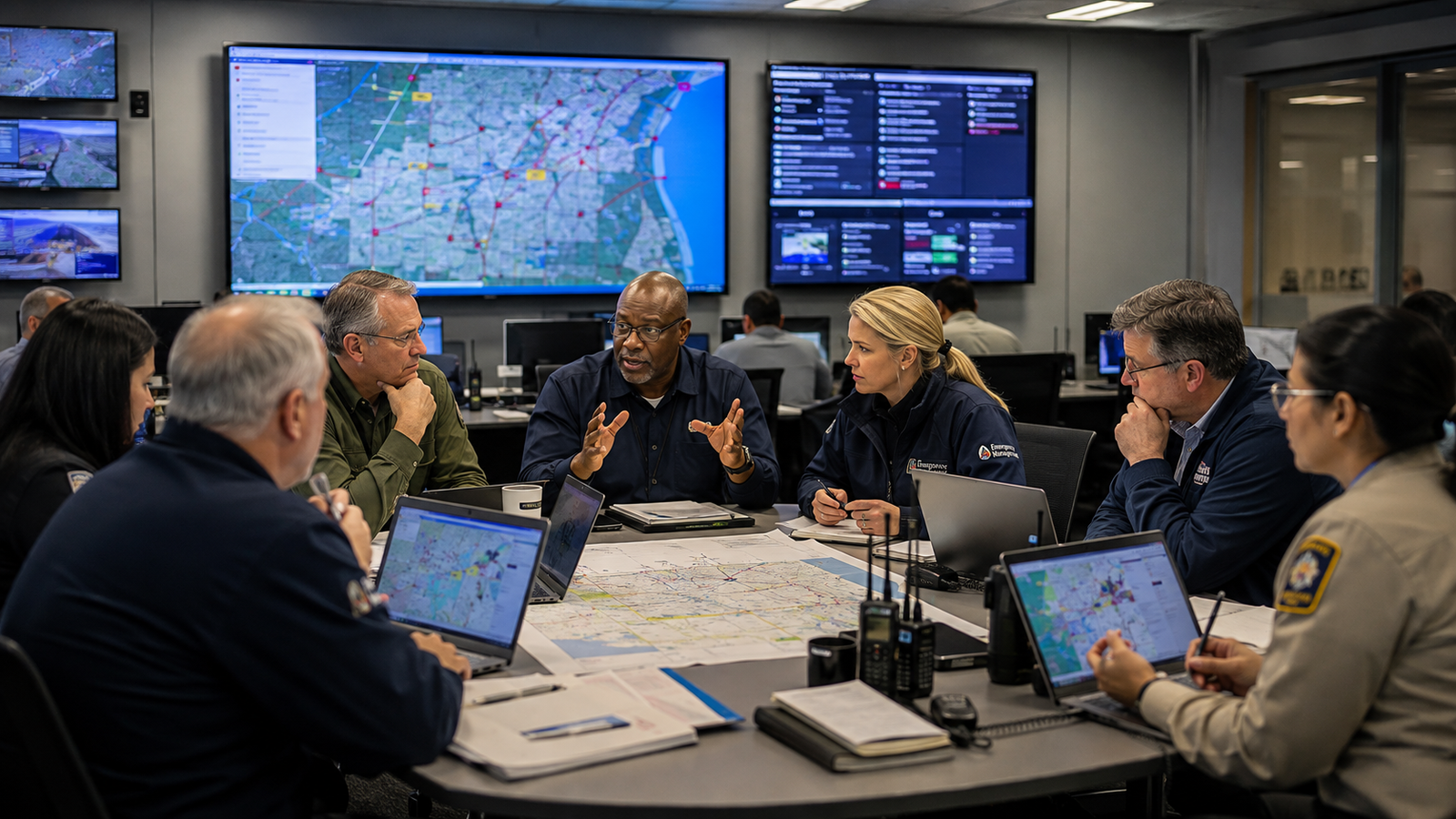
A MAC Group typically consists of agency administrators, executives or their designated representatives from organisations affected by an incident or contributing resources to the response. Depending on the situation, representatives from non-governmental organisations, businesses or volunteer organisations may also participate.
The key phrase to remember is “cooperative multi-agency decisions.” That phrase directly identifies the MAC Group. Its responsibilities can include supporting resource prioritisation and allocation and helping elected or appointed officials coordinate decisions with those responsible for managing the incident.
What Is a Multiagency Coordination Group?
A Multiagency Coordination Group is a policy-level body that helps different agencies work together during an incident. Large emergencies can involve fire services, law enforcement, emergency medical services, public health agencies, public works departments and other organisations. When these organisations have competing priorities or limited resources, coordination becomes extremely important.
The MAC Group provides a forum where senior representatives can consider the wider situation and make decisions that affect multiple agencies. This is particularly useful when resources are limited and difficult choices have to be made about where those resources should go first.
It is important to understand that the MAC Group does not replace the Incident Commander or Unified Command. Instead, it supports the broader incident management structure through policy guidance and resource prioritisation. FEMA specifically notes that MAC Groups do not perform incident command functions.
Why Does the MAC Group Make Cooperative Decisions?
Emergencies rarely stay within the boundaries of one organisation. A major flood, wildfire, earthquake, cyber incident or public safety emergency may require several agencies to respond at the same time. Each organisation may have its own responsibilities, equipment and priorities.
The MAC Group helps bring senior representatives together so they can consider these different needs collectively. Instead of every organisation making isolated decisions, representatives can work towards a coordinated approach that supports the overall response.
This is why the wording of the question is so important. The phrase “cooperative multi-agency decisions” is closely associated with the MAC Group in NIMS training. If you see that wording in a NIMS examination question, the Multiagency Coordination Group is the answer to select.
How Does the MAC Group Support Resource Allocation?
One of the major responsibilities of a MAC Group is supporting the prioritisation and allocation of resources. During a large emergency, there may not be enough personnel, equipment or specialised capabilities to satisfy every request immediately.
For example, several areas might request additional emergency vehicles, specialist teams or communications equipment at the same time. The MAC Group can help establish broader priorities based on the needs and objectives of the incident.
This does not mean that the MAC Group manages every operational resource directly. Instead, it provides policy-level guidance and helps address competing resource needs. FEMA explains that MAC Groups support resource prioritisation and allocation while assisting decision-making between senior officials and incident managers.
MAC Group vs Incident Command System
The Incident Command System, or ICS, is one of the other major NIMS structures. ICS provides a standardised approach for managing incidents, particularly at the operational level. It helps responders establish responsibilities, objectives, communication processes and an organisational structure appropriate to the incident.
The MAC Group has a different role. It works at a policy and coordination level rather than taking over direct incident command. In simple terms, ICS is concerned with managing the incident, while the MAC Group provides broader policy guidance and helps deal with competing resource priorities.
This distinction is useful when answering NIMS questions. If the question asks about on-scene incident management, ICS is likely to be relevant. If it specifically asks which NIMS structure makes cooperative multi-agency decisions, the answer is the MAC Group.
MAC Group vs Emergency Operations Centre
An Emergency Operations Centre, commonly abbreviated as EOC, is another important NIMS structure. EOCs operate away from the immediate incident scene and provide support to incident command and response activities. They can help with information, resources, coordination and other support functions.
Although EOCs and MAC Groups can work closely together, they are not the same thing. An EOC generally supports incident operations and coordination, while a MAC Group serves as a higher-level policy coordination body.
FEMA’s NIMS training explains that EOCs can support on-scene operations while receiving senior-level guidance from MAC Groups. This relationship helps connect operational needs with broader organisational and policy decisions.
MAC Group vs Joint Information System
The Joint Information System, or JIS, is another NIMS command and coordination structure. Its primary purpose is to integrate incident information and public affairs activities so that information released to the public is coordinated, accurate and timely.
The JIS therefore has a communication-focused role rather than being the structure responsible for cooperative multi-agency policy decisions. It can support ICS, EOCs and MAC Groups by helping coordinate public information.
This is another useful distinction for exam preparation. When the question focuses on public messaging, coordinated information or public affairs, think about the JIS. When the question specifically mentions cooperative multi-agency decisions, think about the MAC Group.
The Four NIMS Command and Coordination Structures
NIMS identifies four major command and coordination structures: the Incident Command System (ICS), Emergency Operations Centres (EOCs), Multiagency Coordination Groups (MAC Groups), and Joint Information System (JIS). Together, these structures help organisations coordinate their efforts during incidents.
ICS focuses on on-scene incident management. EOCs provide off-site support and coordination. MAC Groups provide policy guidance and help with scarce or competing resource allocation. JIS coordinates information and public affairs activities across the other structures.
Learning these four roles can make many NIMS questions easier. Rather than memorising individual answers without context, it is better to understand what each structure actually does and how the structures connect during a complex incident.
How These Structures Work Together
The strength of NIMS comes from coordination rather than isolated organisational activity. During a routine incident, local responders may manage the situation through ICS principles. If the event becomes larger or more complex, an EOC may activate to provide additional support.
As the incident creates broader policy or resource issues, a MAC Group can provide senior-level guidance. At the same time, the JIS helps ensure that information released to the public is consistent and coordinated across the incident management structure.
This interconnected approach allows agencies with different responsibilities to work towards common objectives. FEMA describes the command and coordination structures as a framework for managing incidents in a unified and consistent way.
Why Cooperative Multi-Agency Decision-Making Matters
During a major emergency, agencies may have different legal responsibilities, operational capabilities and organisational priorities. Without an effective coordination mechanism, these differences can create delays or competing demands for limited resources.
Cooperative decision-making gives participating organisations a way to consider the incident from a broader perspective. It encourages agencies to share information, understand competing needs and establish priorities that support the overall response.
The MAC Group is especially valuable when senior officials need to make policy-level decisions that affect multiple organisations. It helps connect those officials with the people managing the incident while maintaining the distinction between policy coordination and operational command.
A Simple Way to Remember the Answer
A useful way to remember the answer is to associate the phrase “cooperative multi-agency decisions” directly with MAC Group. The words are closely aligned with FEMA’s own NIMS training terminology.
You can also remember the four structures with a simple functional approach: ICS manages the incident, EOCs support operations, MAC Groups provide policy-level coordination, and JIS coordinates information and public messaging. This is not a replacement for formal training, but it is a practical way to distinguish their roles.
If you are preparing for a NIMS or FEMA-related exam, always pay attention to the exact wording of the question. Terms such as “on-scene management”, “off-site support”, “public information” and “cooperative multi-agency decisions” can point to different NIMS structures.
Frequently Asked Questions
What NIMS structure makes cooperative multi-agency decisions?
The Multiagency Coordination Group (MAC Group) makes cooperative multi-agency decisions. It operates as a policy-level body and can support resource prioritisation and allocation during incidents.
What is the main purpose of a MAC Group?
A MAC Group provides policy-level coordination, supports resource prioritisation and allocation, and helps facilitate decision-making among senior officials and those responsible for incident management.
Does the MAC Group command responders?
No. A MAC Group does not perform direct incident command functions. Operational incident management remains with the appropriate incident command structure, such as ICS or Unified Command.
Is an EOC the same as a MAC Group?
No. An EOC provides off-site support and coordination for incident operations, while a MAC Group functions as a policy-level coordination body. The two can work together during complex incidents.
What are the four NIMS command and coordination structures?
The four structures are the Incident Command System (ICS), Emergency Operations Centres (EOCs), Multiagency Coordination Groups (MAC Groups), and Joint Information System (JIS). Each has a distinct role within NIMS.
Conclusion
So, which NIMS structure makes cooperative multi-agency decisions? The answer is the Multiagency Coordination Group (MAC Group). It brings together senior representatives from stakeholder agencies and organisations to provide policy-level coordination, support resource prioritisation and help facilitate decisions across agencies.
The most important point to remember is that a MAC Group does not replace incident command. Instead, it complements ICS, EOCs and the JIS by providing broader policy guidance and helping organisations deal with competing priorities.
For NIMS exam preparation, remember the key phrase: “cooperative multi-agency decisions = Multiagency Coordination Group.” Once you understand that relationship, this question becomes straightforward and the wider NIMS command and coordination structure becomes much easier to understand.
You May Also Read: Elitemagazin